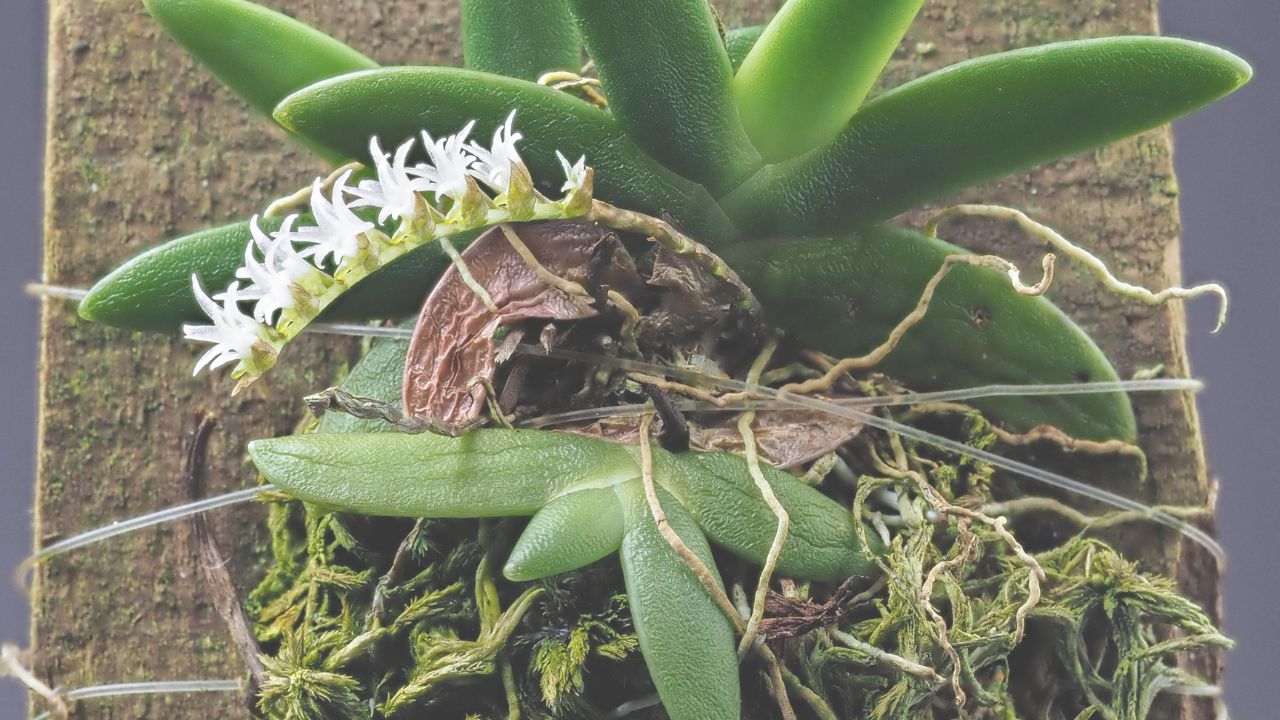
Bolusiella is a small and fascinating group of tropical African orchids valued for its compact growth, unusual fan-shaped foliage, and delicate flowers. The genus belongs to the orchid family Orchidaceae and contains several accepted species distributed across tropical and southern Africa and nearby regions. Bolusiella plants are primarily epiphytic, meaning they naturally grow attached to trees rather than rooted in ordinary soil. Some species can also occur as lithophytes, growing on rocks in suitable humid environments.
Unlike large, showy orchids commonly grown indoors, Bolusiella remains relatively miniature. Its short stems produce tightly arranged leaves, while the flowering stems can carry numerous tiny flowers. Because these plants are adapted to life in humid forests, successful cultivation depends more on providing the right combination of airflow, humidity, bright light, and careful watering than on using a large amount of potting material.
Choosing the Right Growing Location
The first step in growing Bolusiella successfully is selecting an appropriate location. These orchids prefer bright light but should generally be protected from harsh, direct midday sunlight. A bright indoor window with filtered light can work well, while a greenhouse, orchid case, or humid growing area can provide even better conditions.
Bolusiella species come from tropical and subtropical African environments, with different species occurring in wet forests and other humid habitats. This means the exact temperature preference can vary slightly depending on the species. The American Orchid Society recommends intermediate temperatures, very bright light, and frequent watering followed by complete drying of the roots.
Good air circulation is especially important. Humid air without movement can encourage fungal and bacterial problems. A small fan providing gentle air movement can help keep the foliage and growing surface healthier without creating a strong, drying draft.
Selecting the Best Growing Method
Because Bolusiella is naturally epiphytic, mounting is often one of the most suitable ways to grow it. A small piece of cork bark, tree fern material, or another appropriate orchid-mounting surface can provide the plant with the open root environment it naturally prefers.
The American Orchid Society specifically recommends growing Bolusiella on slabs without moisture-retaining material around the roots. This approach allows the roots to receive plenty of air and dry naturally after watering.
Bolusiella can also be grown in a small pot, but container cultivation requires greater attention to watering. A pot should never remain constantly wet around the roots. If the growing medium stays saturated for extended periods, the fine roots may deteriorate and eventually rot.
For beginners, a small container with excellent drainage can be easier to manage than a large pot. The container should be only slightly larger than the root system, because excessive unused medium can retain moisture for too long.
Choosing Soil and Growing Medium
Bolusiella does not behave like a typical terrestrial houseplant, so ordinary garden soil is not suitable. Dense soil can hold too much water around the roots and prevent the air circulation that epiphytic orchids need.
For potted plants, use a very open orchid medium that drains rapidly. Fine to medium orchid bark can be combined with a small amount of another airy material if necessary. The goal is not to create a permanently wet environment but to provide temporary moisture while allowing plenty of air around the roots.
When mounted, the plant may require little or no traditional growing medium. The roots can be attached directly to the mount, allowing them to dry quickly after watering. This method is particularly useful for growers who can provide regular watering and adequate humidity.
Avoid packing the roots tightly into a dense mixture. Bolusiella has a delicate root system, and good ventilation around the roots is one of the most important factors in long-term cultivation.
Watering Bolusiella Correctly
Watering is one of the most important parts of Bolusiella care. The plant appreciates frequent moisture but does not want its roots sitting wet continuously. The American Orchid Society recommends frequent watering while allowing the roots to fully dry between waterings.
The exact watering schedule depends on temperature, humidity, airflow, growing method, and season. A mounted plant may dry much faster than one growing in a small pot. During warm, bright weather, it may require more frequent watering. During cooler or darker periods, watering should be adjusted downward.
When watering, thoroughly wet the roots and growing surface rather than giving only a few drops. After watering, allow excess water to drain away completely. Avoid leaving water trapped around the base of the plant for long periods.
The roots should be observed regularly. Healthy roots generally indicate that the watering routine is working well, while consistently soft, dark, or deteriorating roots can indicate excessive moisture or poor airflow.
Providing Proper Humidity
Humidity is important because Bolusiella originates mainly from humid natural environments. Several species are associated with wet tropical forests, although the natural habitat differs among species. For example, Kew records Bolusiella zenkeri as an epiphytic plant of wet tropical regions in western and west-central tropical Africa.
Indoor growers should aim for reasonably humid air while maintaining good ventilation. A humidifier can be useful in a dry room, especially during winter when indoor heating reduces atmospheric humidity.
However, humidity should not be treated as a substitute for watering or airflow. Extremely humid, stagnant conditions can create problems. The ideal environment provides moisture in the air while allowing the plant and its roots to dry appropriately after watering.
Light Requirements for Healthy Growth
Bolusiella prefers bright light, and insufficient light can result in weak growth and poor flowering. The American Orchid Society lists very bright light among the recommended cultural conditions for the genus.
An east-facing or bright filtered window can be a useful indoor position. If the plant is kept behind glass where sunlight becomes intense, sheer curtains can help reduce the risk of leaf damage.
Artificial grow lights can also work well. Place the plant close enough to receive strong, consistent illumination without generating excessive heat. If the leaves begin showing signs of bleaching or scorching, move the plant farther away from the light source or provide additional filtration.
Temperature and Air Circulation
Intermediate temperatures are generally appropriate for Bolusiella cultivation. Because the genus includes species from different African habitats, individual plants may vary somewhat in their preferred conditions.
Avoid extreme temperature changes whenever possible. Good ventilation is particularly important in warm conditions because moving air helps prevent the plant from remaining wet for too long.
A gentle fan can improve circulation around mounted plants and containers. The airflow should be indirect and moderate rather than strong enough to dry the plant immediately.
Feeding and Fertilizing
Bolusiella can benefit from light, regular feeding during active growth. Use a balanced orchid fertilizer at a reduced strength rather than applying heavy doses. Because the plant is small, excessive fertilizer can accumulate around the roots and cause damage.
Fertilize only when the plant is actively growing and the roots are healthy. Watering the plant first and then applying a diluted fertilizer solution can help reduce the chance of concentrated fertilizer contacting dry roots.
During periods of slow growth, reduce feeding. Good light, proper watering, and healthy roots are more important than heavy fertilization.
Propagating Bolusiella
Propagation of Bolusiella is not usually as simple as propagating common houseplants. These orchids are naturally compact, and they do not normally produce large numbers of easily separable divisions.
Propagation from seed is possible for orchids but is technically demanding because orchid seeds are extremely small and normally require specialized sterile conditions and appropriate fungal or laboratory-assisted techniques for successful development.
For home growers, vegetative propagation may be possible when a mature plant naturally develops suitable growths that can be separated without damaging the remaining plant. However, unnecessary division should be avoided because small orchid plants can take considerable time to recover.
The safest approach is usually to maintain a healthy mature specimen and allow it to develop naturally rather than attempting frequent propagation.
Repotting and Mount Maintenance
Bolusiella should not be repotted unnecessarily. If the plant is growing well and the mounting material remains stable, disturbing the roots can create more stress than benefit.
For potted plants, repot when the medium has broken down, drainage has become poor, or the roots are clearly struggling because of the condition of the growing material. Choose a small container rather than moving the plant into a much larger pot.
When mounting a Bolusiella, secure the plant gently so that it cannot move excessively while new roots establish. Avoid tying or fastening the plant so tightly that the growing tissues become damaged.
Common Growing Problems
The most common problems usually involve watering, light, humidity, and airflow. Root rot can develop when the roots remain wet for too long, especially in poorly ventilated containers. The solution is to improve drainage, increase airflow, and adjust watering frequency.
Leaf damage can occur when bright sunlight becomes too intense. On the other hand, very low light can reduce growth and flowering. Finding a bright but filtered position is therefore important.
Dry air can cause the plant to lose moisture rapidly, particularly when mounted. Increasing humidity and watering appropriately can help, but the plant should still receive adequate airflow.
Pests such as scale insects, mealybugs, and other orchid pests can occasionally appear. Inspect the leaves, stems, and roots regularly so that any problem can be addressed early.
Seasonal Bolusiella Care
Bolusiella care should change slightly with the seasons. During periods of stronger growth, the plant may need more frequent watering and occasional feeding. Bright light and active airflow are particularly valuable during this time.
During cooler or darker periods, growth may slow and the plant may use water more slowly. Reduce watering accordingly rather than following a fixed calendar schedule.
The best approach is to observe the plant and its growing environment. Check how quickly the roots and mounting surface dry, monitor the leaves, and adjust care according to actual conditions.
Final Tips for Growing Bolusiella at Home
Growing Bolusiella successfully is mainly about recreating the open, airy conditions of an epiphytic orchid rather than treating it like a conventional potted plant. Bright filtered light, intermediate temperatures, good humidity, excellent airflow, and careful watering form the foundation of healthy growth.
Mounting the plant can be especially effective because it allows the roots to remain exposed and dry naturally. If you prefer container cultivation, choose a small pot and an extremely open orchid medium with excellent drainage.
Patience is also important. Bolusiella is a miniature orchid, and its growth and flowering should not be rushed with excessive fertilizer or constant watering. With stable conditions and careful observation, this unusual African orchid can become a rewarding addition to a specialist orchid collection. Its compact form, distinctive foliage, and delicate flowers make it an excellent choice for growers who enjoy cultivating less-common orchid species.
